

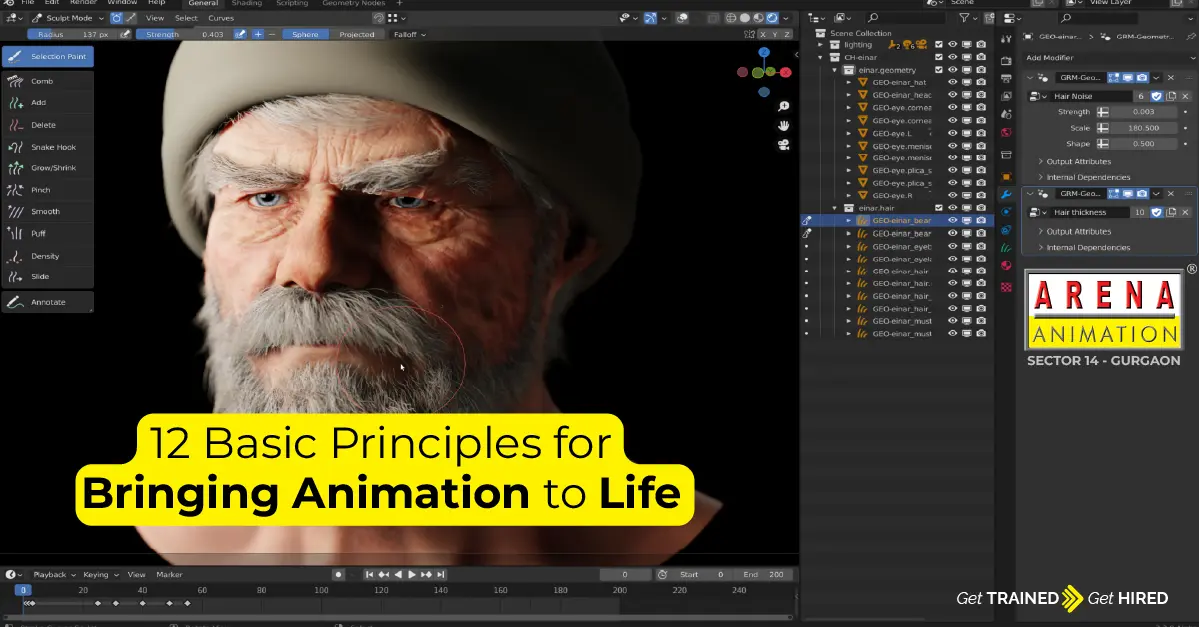
Animation, one of the most trending topics, has taken the place of many core areas, including boring physical invitation cards, profile pictures, the entertainment industry, teaching, and more. It is not a snapping fingers game but a lot that is defined under the 12 basic principles.
12 Basic Principles Of Animation were described in the book- “The Illusion Of Life” by Frank Thomas and Ollie Johnston, the animators at Walt Disney Animation Studios. All these principles define a clear understanding of animation.
What Are The Principles of Animation?
Animation revolves around some well-defined principles. There is a principle named Appeal which has a subjective nature unlike other practical approaches. It is subjective, but that doesn't mean it is the least important, its importance is realised when you have the end result of animation in your hands.
These 12 Basic Principles Of Animation were created with the purpose of producing an illusion that the animated characters adhere to the basic laws of physics but while dealing with more abstract issues like emotional timing and character appeal.
12 Basic Principles Of Animation
The book- “The Illusion of Life” was referred to as a Bible of Animation and was declared the best animation book in an online poll. Let's now see the 12 principles of animation defined in the book:
1)- Squash and Stretch
This very first principle of animation defines the weight and flexibility of a particular object in Animation.
Example: When you hit a bouncing ball on the ground, it will be squashed and then stretched after a bounce.
2)- Anticipation
The purpose of this principle is to capture the attention of the audience towards the coming action, especially in professional Animation training.
Example: A jumping character has to bend his knees first and then stand straight on his toes to jump.
3)- Staging
This principle grabs the focus of the audience towards the important scenes while avoiding unnecessary details. It is widely used in Broadcast and visual storytelling.
Example: Proper use of light and shadow, placing the character, camera directions and more.
4)- Straight-ahead action and pose to pose
There are two approaches to drawing any object for animation:
- Straight-ahead action: It implies drawing frame by frame or from beginning to end to produce realistic action sequences used in Gaming.
- Pose to pose: It implies drawing key frames first and then later the intervals to create dramatic and emotional scenes.
5)- Follow Through and Overlapping Action
The idea of Thomas and Ollie behind this principle is to create a realistic scene by moving some of the objects while remaining others constant. This technique is essential in Digital Content Creation & Motion Graphics.
Example: Movement of hair or clothes even when the character stands still.
6)- Slow In & Slow Out
Any object of the real world follows the slow in slow out principle. In animation, to create this slow-in & slow-out effect, many other objects have to be added to the picture. These concepts are also important in Graphic, Web & UI/UX design motion transitions.
7)- Arc
For greater realism, natural movements must follow curved paths rather than straight lines — a core part of professional Animation courses.
Example: If as an animator, you have to show a pointed finger, then to show the movement for a still finger, the arc principle will apply.
8)- Secondary Actions
A secondary action acts as a supported action for the main action to give life to the animation and grab the interest of the audience.
Example: If a man is walking, you can add a secondary action of swinging his arms to add life to the scene.
9)- Timing
The number of frames used in any action that affects the speed and emotion of a particular scene is the goal of this principle. Timing plays a crucial role in Game Design and animated storytelling.
10)- Exaggeration
Exaggerating a scene in animation means keeping the reality while displaying it in a wilder and more extreme form. This technique enhances visual impact in Motion Graphics.
11)- Solid drawing
The animator needs to be a skilled artist with proper knowledge of 3D shapes, lights, shadows, volume, weight, balance and anatomy — fundamentals taught in professional Animation training programs.
Example: The left and right sides of the twins mirrored each other.
12)- Appeal
It means adding charisma to the characters that are more interesting, appealing and engaging — an essential quality developed at a leading Animation Institute Gurgaon.
Example: Whether it is a hero, villain, or side actor, every character has to be visually engaging.
Conclusion
An animator should be well acquainted with the 12 Basic Principles of Animation. Any animation must follow these principles to add life to its non-living objects that can grab the entire attention of the audience. Don't misunderstand the Appeal principle by making it beautiful but more engaging like the Joker from The Dark Knight or the heroes of Power Puff Girls.
Frequently Asked Questions (FAQs)
Q1. What is the most important principle?
A- Squash and Stretch as it gives life to an object.
Q2. What are the 12 principles of animation?
A- Squash and Stretch, Anticipation, Staging, Straight ahead action and pose to pose, Follow through and overlapping action, Slow In & Slow Out, Arc, Secondary Action, Timing, Exaggeration, Solid Drawing and Appeal.
Q3. What is Appeal in animation?
A- It implies adding charisma to the animated character, whether it is a villain, hero or other.